"L'espace pour l'Europe, l'Europe pour l'espace." Space for Europe, Europe for space. It is a phrase you hear repeated in the corridors of ESA's Paris headquarters, in the clean rooms of ESTEC in the Netherlands, in the mission control halls of Darmstadt, Germany. It sounds like a slogan. It is actually a minor miracle.
Consider the improbability. Twenty-three sovereign nations -- speaking dozens of languages, operating under different legal systems, answering to different electorates, carrying different historical grievances -- voluntarily pool billions of euros every three years to design, build, and fly some of the most complex machines ever constructed. They argue about budgets in French and German. They negotiate industrial contracts across time zones from Lisbon to Helsinki. They have been doing this, with increasing ambition and increasing success, for half a century.
The European Space Agency is not NASA with a continental accent. It is something stranger and, in some ways, more remarkable: an intergovernmental organization in which no single nation has a veto, no single nation dominates, and every member state is guaranteed that its financial contribution will flow back to its own industries in the form of contracts. It is the largest peacetime scientific collaboration in European history outside of CERN. And unlike CERN, which probes the fundamental structure of matter in a single laboratory under the Swiss-French border, ESA's work is distributed across a continent -- rockets assembled in Bremen, tested in Lampoldshausen, and launched from the equatorial jungle of French Guiana; Earth-observation satellites designed in Turin, calibrated in Noordwijk, and controlled from Darmstadt; astronauts trained in Cologne, launched from Cape Canaveral or Baikonur, and monitored from Munich.
This is Part 1 of a comprehensive two-part series on the European Space Agency. Part 1 traces the institutional story -- the political origins in Cold War Europe, the painful failures that forged the agency, its unique governance, its launcher dynasty from Europa to Ariane 6, and its astronaut corps. Part 2 will examine the missions that made ESA a scientific superpower: Copernicus, Galileo, Rosetta, JUICE, Euclid, the Lunar Gateway, and the strategic choices that will define Europe's place in the new space race.

The Seeds: ESRO, ELDO, and the Dream of European Space (1958--1975)
The story begins, as so many European stories do, in the rubble of a war and the shadow of two superpowers.
By 1957, both the Soviet Union and the United States had demonstrated that access to space was a prerequisite of great-power status. Sputnik shocked the world in October; Explorer 1 followed in January 1958. For the nations of Western Europe -- individually wealthy but collectively humbled, rebuilding democracies on the ruins of empires -- the lesson was uncomfortable. No single European country could afford a space program that rivaled Washington or Moscow. But together, perhaps, they could build something meaningful.
The intellectual catalyst was a group of scientists, many of them veterans of the International Geophysical Year of 1957--58, who argued that Europe needed its own capability for space research. In 1958, the physicist Edoardo Amaldi of Italy and the space scientist Pierre Auger of France began lobbying for a European space research body, modeled loosely on CERN, which had demonstrated since 1954 that multinational European science could work. Their efforts bore fruit in 1962, when two separate organizations were created to address the two pillars of any space program: science and launch capability.
The European Space Research Organisation (ESRO), established by convention on June 14, 1962, would build scientific satellites and the ground infrastructure to support them. Its founding members were Belgium, Denmark, France, Germany, Italy, the Netherlands, Spain, Sweden, Switzerland, and the United Kingdom. ESRO was, from the start, the more successful of the two siblings. By the end of its existence in 1975, it had launched eight scientific satellites and built a network of ground stations, technical centers, and mission control facilities that would form the physical backbone of ESA.
The European Launcher Development Organisation (ELDO), also established in 1962, had a harder task and a harder time. ELDO's mission was to give Europe independent access to space -- a launcher that did not depend on American goodwill or Soviet politics. Its founding members were Australia, Belgium, France, Germany, Italy, the Netherlands, and the United Kingdom. The organizational structure was, in retrospect, a recipe for failure: each major component of the three-stage Europa rocket was assigned to a different country. Britain would provide the first stage, based on its Blue Streak ballistic missile. France would build the second stage, called Coralie. Germany would contribute the third stage, Astris. Italy would develop the satellite test vehicle, Belgium the ground guidance system, and the Netherlands the telemetry links.
What sounds like an elegant division of labor was, in practice, a nightmare of competing national engineering cultures, incompatible interface specifications, and finger-pointing when things went wrong. And things went wrong with depressing regularity.
Between 1964 and 1971, ELDO conducted ten launches of the Europa I rocket from the Woomera Range in South Australia, and one launch of the more ambitious Europa II from the Centre Spatial Guyanais in Kourou, French Guiana. The results were catastrophic. Although the British Blue Streak first stage performed reliably on every flight, the upper stages failed time after time. The French second stage failed. The German third stage failed. The guidance system failed. Integration between stages failed. Not a single Europa rocket successfully placed a satellite into orbit. The entire program -- all eleven launches, across seven years -- produced nothing but wreckage and recrimination.
The Europa II launch from Kourou on November 5, 1971, was the final indignity. The rocket exploded approximately 150 seconds after liftoff, destroying the test satellite it carried. The explosion also destroyed, symbolically, the idea that Europe could build a launcher through a loose confederation of national programs without unified technical management.
The history of ELDO, as space historian John Krige has written, was "one of technological failure, cost overruns and political dispute." But the failure was not meaningless. It taught European leaders a lesson they might never have learned from success: that piecemeal cooperation, where each nation jealously guards its own piece of the rocket and no one is responsible for the whole, does not work. Europe needed a single, unified space agency with genuine authority over the entire development chain -- from concept to launch pad.
The Birth of ESA (May 30, 1975)
The merger negotiations took years. ESRO and ELDO had different members, different cultures, different budgets, and different ideas about what a combined agency should prioritize. France wanted launchers above all else -- President de Gaulle's legacy of strategic independence ran deep. Germany and the United Kingdom cared more about science and applications satellites. Smaller countries wanted guarantees that they would not be steamrolled by the big three.
The breakthrough came with a political bargain that, in various forms, continues to define ESA to this day. France got its launcher: the new agency would develop Ariane, a rocket designed and managed by France under ESA oversight, with French industry as prime contractor. Germany got a major role in the Spacelab program, a pressurized laboratory module that would fly in the cargo bay of NASA's forthcoming Space Shuttle. Everyone got the principle of juste retour.
On May 30, 1975, in Paris, the Convention for the Establishment of a European Space Agency was opened for signature. The original signatories were the Federal Republic of Germany, Belgium, Denmark, Spain, France, Italy, the Netherlands, the United Kingdom, Sweden, and Switzerland. Ireland signed on December 31, 1975. The Convention entered into force on October 30, 1980, although ESA had been operating de facto since 1975 by absorbing the staffs and programs of both ESRO and ELDO.
The founding convention established several principles that remain central to ESA's identity:
Juste retour (fair return): This is arguably ESA's most distinctive and most debated feature. The principle guarantees that each member state receives industrial contracts roughly proportional to its financial contribution. If Germany contributes 22 percent of the budget for an optional program, approximately 22 percent of the industrial work on that program must go to German companies. The system ensures political buy-in -- no parliament will vote for contributions that send all the money abroad -- but it also means that contracts cannot always go to the lowest bidder or the most technically capable firm. Critics call it inefficient. Defenders call it the glue that holds a 23-nation agency together. Both are right.
Mandatory and optional programs: ESA's activities are divided into two categories. Mandatory activities -- the basic science program and the agency's general operating budget -- are funded by all member states according to their gross national income. No one can opt out. Optional programs cover everything else: Earth observation, telecommunications, navigation, human spaceflight, launchers, exploration. Each member state chooses which optional programs to join and how much to contribute. This a la carte system means that not every ESA member participates in every program, but it also means that ambitious programs can proceed even if some countries decline to fund them.
Headquarters in Paris: The agency's political and administrative headquarters was established at 8-10 rue Mario-Nikis in the 15th arrondissement of Paris, a location it occupies to this day. The choice of Paris reflected France's dominant role in European space policy and its status as the largest contributor to early ESA budgets.
ESA is not the EU: This point cannot be overemphasized, because it is the single most common misconception about European space. The European Space Agency and the European Union are entirely separate organizations with different memberships, different governance structures, and different legal foundations. ESA is an intergovernmental body; the EU is a supranational one. ESA has members that are not in the EU (the United Kingdom, Switzerland, Norway), and the EU has members that are not in ESA (several Eastern European states). Canada has been a Cooperating State within ESA since 1979, participating in programs and deliberations despite being an ocean away. The EU commissions ESA to develop and operate certain programs (Copernicus, Galileo) under delegation agreements, but ESA answers to its own Council of Ministers, not to the European Commission. The relationship is close, often productive, and occasionally fraught with institutional tension -- but it is a partnership between two distinct entities.
ESA's Structure Today: 23 Nations, Five Centers, One Mission

As of January 1, 2025, ESA has 23 member states: Austria, Belgium, the Czech Republic, Denmark, Estonia, Finland, France, Germany, Greece, Hungary, Ireland, Italy, Luxembourg, the Netherlands, Norway, Poland, Portugal, Romania, Slovenia, Spain, Sweden, Switzerland, and the United Kingdom. Slovenia, the newest member, acceded to the ESA Convention on January 1, 2025. Latvia, Lithuania, and Slovakia hold Associate Member status. Canada continues as a Cooperating State with full participation rights in programs and deliberations.
The agency is led by Director General Josef Aschbacher, an Austrian Earth-observation scientist who took office on March 1, 2021. His mandate was renewed for a further four-year term beginning March 1, 2025 -- a vote of confidence that reflects the steady hand he has shown through the Ariane 6 development, the Soyuz crisis, and the geopolitical upheavals of the early 2020s. At his annual press briefing in Paris on January 8, 2026, Aschbacher announced that 2026 would be a record year for ESA, with 65 missions and satellites planned for launch -- an unprecedented tempo.

ESA's operations are distributed across five major establishments, each with a distinct role:
ESTEC (European Space Research and Technology Centre), Noordwijk, the Netherlands. This is ESA's largest facility and its technical heart, employing roughly 2,500 of the agency's approximately 7,000 staff. ESTEC houses the test facilities where virtually every European spacecraft is subjected to the vibration, thermal vacuum, electromagnetic compatibility, and acoustic environments it will face during launch and in orbit. If a satellite flies under an ESA flag, it almost certainly passed through ESTEC's clean rooms.
ESOC (European Space Operations Centre), Darmstadt, Germany. This is mission control -- the facility where flight controllers monitor and command ESA's fleet of orbiting spacecraft. ESOC's main control room has directed operations for missions ranging from Rosetta's comet rendezvous to Gaia's billion-star survey. It maintains a global network of ground stations (the ESTRACK network) that provides continuous communication links with spacecraft across the solar system.
ESRIN (European Space Research Institute), Frascati, Italy. Located in the hills southeast of Rome, ESRIN serves as ESA's center for Earth observation. It manages the ground segment for ESA and third-party Earth-observation satellites and maintains what is probably the largest archive of environmental data in Europe. If you have ever used satellite-derived data on deforestation, ocean temperatures, or atmospheric composition, there is a good chance it passed through ESRIN.
EAC (European Astronaut Centre), Cologne, Germany. This is where ESA's astronauts train. The facility houses full-scale mockups of the International Space Station's European modules, a neutral-buoyancy pool for simulated spacewalks, and medical and rehabilitation facilities. All of ESA's career astronauts are based here.
CSG (Centre Spatial Guyanais), Kourou, French Guiana. Europe's spaceport, shared with France's CNES, sits on the northeastern coast of South America at latitude 5.2 degrees north -- close enough to the equator to give rockets a significant boost from Earth's rotational velocity. It is from here that Ariane, Vega, and formerly Soyuz rockets launch European payloads into orbit.
How ESA Works: Ministerial Councils, Budgets, and the Art of Continental Consensus
Understanding ESA requires understanding its decision-making process, which is fundamentally different from NASA's. NASA is a US government agency whose budget is decided by the American Congress and signed by the American president. ESA's budget is decided by 23 governments, each with its own parliament, its own fiscal pressures, and its own space priorities.
The apex of ESA decision-making is the Council at Ministerial Level -- a summit held every two to three years at which the ministers responsible for space policy in each member state gather to set the agency's direction and commit funding for the next budget cycle. These Ministerial Councils are high-stakes political theater. National delegations arrive with negotiating positions honed over months. The Director General presents an agenda of programs with price tags. Over two or three days of intense bargaining, ministers decide which programs to fund, at what level, and with what conditions.
The most recent Ministerial Council, CM25, was held in Bremen, Germany, in November 2025. It was, by any measure, historic. Member states collectively committed 22.3 billion euros over the 2026--2028 period -- the largest budget in ESA's 50-year history. The figure represented a 30-percent increase over the previous cycle and came within 99 percent of the amount the Director General had requested. Aschbacher himself remarked that it was the first time he could recall an agreement coming so close to the agency's full ask.
The 22.3 billion euros were allocated across ESA's program domains. The largest single allocation -- 4.4 billion euros -- went to space transportation, funding continued Ariane 6 operations, Vega-C launches, and the European Launcher Challenge for commercial startups. Earth observation received major investment for the next generation of Copernicus Sentinel satellites. Science secured funding for missions to Mars, Jupiter's moons, and beyond. Exploration programs, including Europe's contributions to the Lunar Gateway and the Rosalind Franklin Mars rover (targeted for 2028 launch), received strong backing.
The budget translates to approximately 8.26 billion euros per year for 2026 -- a sum that, while dwarfed by NASA's roughly $25 billion annual budget, makes ESA the world's second-largest civilian space agency by spending. On a per-capita basis, the comparison is even more interesting: ESA serves a population of roughly 550 million people across its member states, giving it substantial scale for multinational missions.
The mandatory-vs-optional structure means that not every euro is decided at the ministerial level. The mandatory science program (roughly 600 million euros per year) and general budget are determined by weighted contributions based on gross national income. But the optional programs -- which account for the majority of ESA's budget -- are negotiated country by country, program by program, in the kind of continental horse-trading that has no equivalent at NASA or JAXA or any other national space agency.
There is a deeper political dynamic at work. Because of juste retour, every euro a country contributes to an optional program is an investment in its own aerospace industry. When Germany contributes to Ariane 6, German companies in Bremen and Lampoldshausen get Ariane 6 contracts. When Italy contributes to Vega-C, Italian companies like Avio get Vega-C work. This creates a positive feedback loop: national industries lobby their governments to contribute to ESA programs, because ESA contracts are some of the most technically prestigious and commercially valuable work in European aerospace. The system is not perfectly efficient -- sometimes the best company for a job is in the wrong country -- but it has sustained political support for European space investment across five decades, through economic crises, changes of government, and shifting national priorities.
The Launcher Saga: From Europa's Ashes to Ariane's Triumph
If ELDO's Europa was European space cooperation's original sin, Ariane was its redemption. The story of how Europe went from a rocket that never worked to a rocket family that dominated the global commercial launch market for two decades is one of the great engineering and political narratives of the twentieth century.
The key decision came in 1973, two years before ESA formally existed. At a European Space Conference in Brussels on July 31, 1973, European ministers agreed to develop the L3S (Lanceur de troisième génération substitution) -- a three-stage launcher that would give Europe the ability to place telecommunications satellites into geostationary transfer orbit. France would lead the development, with the Centre National d'Etudes Spatiales (CNES) as the responsible agency. Unlike Europa's fragmented structure, L3S would have a single prime contractor and a single technical authority. The rocket was subsequently named Ariane, after the Greek mythological figure Ariadne.
Development took six years. On December 24, 1979 -- Christmas Eve -- the first Ariane 1 lifted off from the Centre Spatial Guyanais in Kourou, French Guiana. The launch was successful, placing a technology demonstration payload into orbit. French President Valery Giscard d'Estaing personally pressed the firing button. After more than a decade of Europa failures, Europe finally had a working rocket.
Ariane 1 flew eleven times between 1979 and 1986, with two failures -- a respectable record for a new launch vehicle. But it was Ariane 4, introduced in 1988, that turned Europe into a genuine launch power.
Ariane 4 was a modular workhorse. Its basic design could be augmented with various combinations of solid and liquid strap-on boosters, creating six different configurations (AR40, AR42P, AR44P, AR42L, AR44LP, AR44L) capable of placing payloads from 2,100 to 4,900 kilograms into geostationary transfer orbit. This flexibility, combined with competitive pricing and the reliability that came from a maturing industrial base, made Ariane 4 the rocket of choice for the global commercial satellite industry throughout the 1990s. Over 15 years and 116 launches, it suffered just three failures -- a 97.4-percent success rate. At its peak, Ariane 4 captured roughly 50 percent of the global commercial launch market, a dominance that no European rocket had achieved before or has achieved since.
Ariane 5, which debuted on June 4, 1996, was designed for an era of heavier payloads and dual-launch capability. Where Ariane 4 was an evolution of Ariane 1's architecture, Ariane 5 was a clean-sheet design: a massive Vulcain cryogenic main engine, two enormous solid rocket boosters, and an upper stage capable of delivering two large satellites to geostationary orbit on a single flight.
The debut was a disaster. On its maiden flight, Ariane 5 veered off course 37 seconds after liftoff and self-destructed. The cause was a software error -- a 64-bit floating-point number from the inertial reference system was converted to a 16-bit signed integer, causing an overflow that crashed the guidance computer. The code had been reused from Ariane 4 without adequate testing for the new rocket's different flight profile. It became one of the most studied software failures in engineering history, a case study taught in computer science courses worldwide.
ESA and Arianespace recovered. After the initial failure and one partial failure, Ariane 5 went on to compile an extraordinary record: 117 flights over 27 years, with only a handful of anomalies. Its crowning achievement came on Christmas Day 2021, when an Ariane 5 ECA launched the James Webb Space Telescope -- the most expensive and most scientifically ambitious space observatory ever built -- into a trajectory toward the Sun-Earth L2 Lagrange point, 1.5 million kilometers from Earth. NASA had entrusted its $10-billion flagship to a European rocket, and Ariane 5 delivered it so precisely that JWST's onboard fuel budget was extended by years, potentially extending the telescope's operational life well beyond its design specification.
The final Ariane 5 flew on July 6, 2023, carrying communications satellites for Germany and France. Over its career, Ariane 5 had launched telecommunications satellites, scientific missions, military payloads, and cargo to the International Space Station (via the Automated Transfer Vehicle, or ATV). It was, by any reasonable measure, one of the most successful heavy-lift rockets in history.
Ariane 6 and the Launcher Crisis of 2022
The transition from Ariane 5 to Ariane 6 was supposed to be seamless. Ariane 6, designed as a more cost-competitive successor with a modular architecture (two-booster Ariane 62 and four-booster Ariane 64 variants), was originally intended to fly by 2020. Development delays, technical challenges with the new Vinci upper-stage engine, and the disruptions of the COVID-19 pandemic pushed the inaugural flight back repeatedly.
Then came February 2022, and the launch calendar went from delayed to dire.
On February 24, 2022, Russia invaded Ukraine. Within 48 hours, the European response included economic sanctions against Russian entities. On February 26, Roscosmos Director General Dmitry Rogozin announced that Russia was suspending all Soyuz launch operations from the Centre Spatial Guyanais in Kourou and withdrawing Russian personnel from French Guiana. The decision was immediate and total. Soyuz rockets sitting on the pad in Kourou were abandoned by their Russian launch crews.
The consequences for European space were severe. Soyuz had been launching from Kourou since 2011, filling the gap between Ariane 5 (heavy-lift) and Vega (small-lift) as a reliable medium-lift option. Several critical institutional missions -- including Galileo navigation satellites, the Euclid space telescope, and the EarthCARE climate mission -- had been manifested on Soyuz from Kourou. Overnight, these payloads had no ride to space.
To make matters worse, Vega-C, the upgraded small launcher built by Italian firm Avio, suffered its own crisis when its second flight on December 21, 2022, failed due to a defect in the Zefiro-40 second-stage motor nozzle, resulting in the loss of two Pleiades Neo Earth-imaging satellites. Vega-C was grounded for nearly two years while the motor was redesigned.
For a period in 2023, Europe had essentially no independent access to space. Ariane 5 was retired. Ariane 6 was not yet ready. Soyuz was gone. Vega-C was grounded. Payloads were stranded. It was the most acute launcher crisis in ESA's history, and it underscored with brutal clarity why independent access to space -- the founding motivation of ELDO in 1962 -- remains an existential priority for Europe.
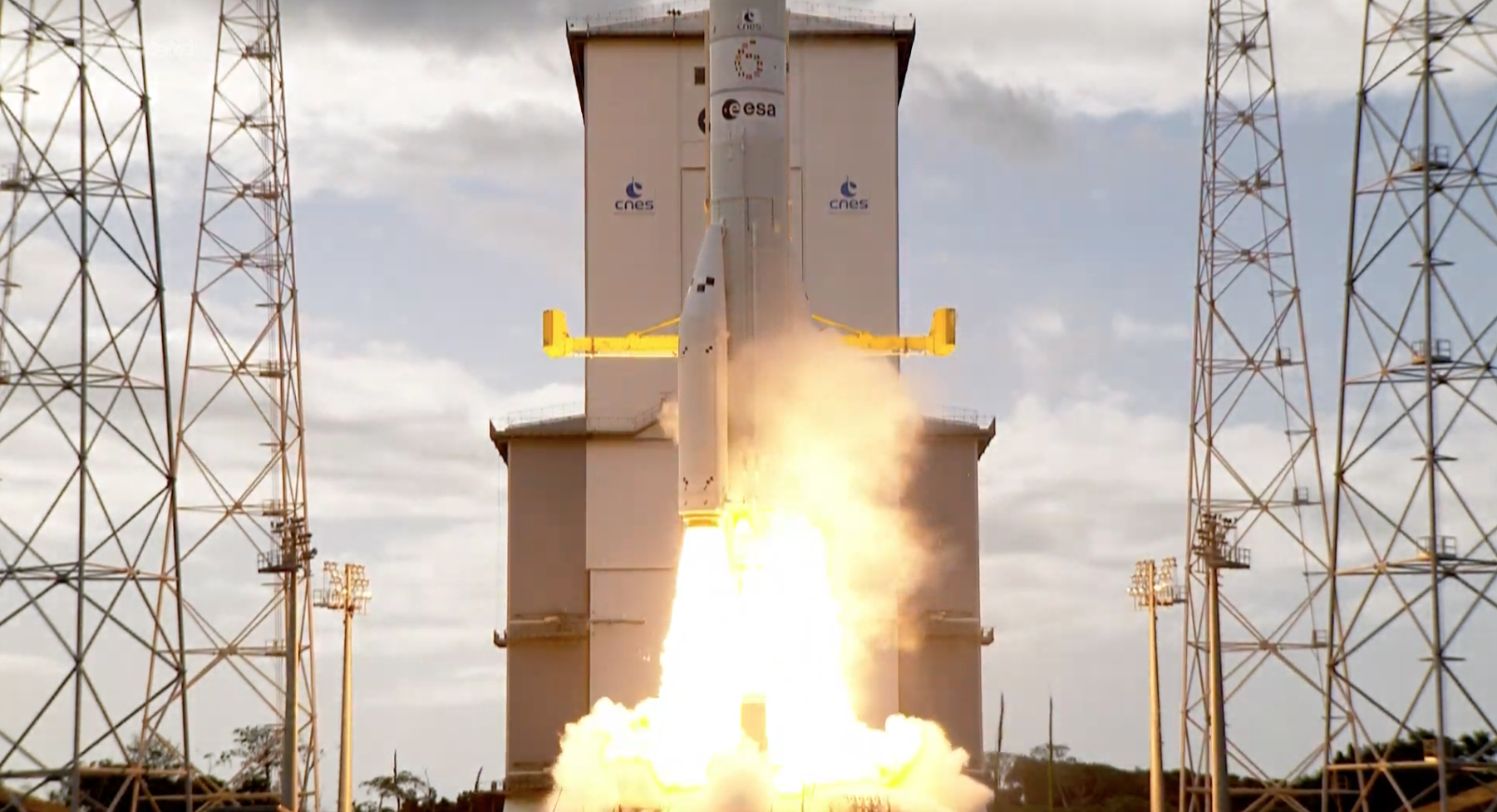
The crisis eased gradually. Ariane 6 finally flew its inaugural mission on July 9, 2024, lifting off from the newly built ELA-4 launch complex in Kourou. The two-booster Ariane 62 variant successfully delivered 17 small payloads to orbit, restoring European independent access to space after a year-long gap. There was an anomaly -- the auxiliary power unit on the upper stage malfunctioned during the third burn, preventing a planned deorbit of the upper stage -- but the primary mission objectives were achieved.
Ariane 6's second flight came on March 6, 2025, successfully delivering the CSO-3 military reconnaissance satellite for France. The third and fourth flights followed later in 2025, including the launch of Galileo L14 navigation satellites in December. By the end of 2025, Ariane 6 had flown five times -- four in 2025 alone -- with all primary payloads successfully delivered. The four-booster Ariane 64 variant made its debut on February 12, 2026, carrying 32 satellites for Amazon's Project Kuiper constellation, the first in a series of 18 Ariane 6 missions contracted by Amazon.
Arianespace is aiming for six to eight Ariane 6 launches in 2026 -- a cadence that, if achieved, would put Europe back in the business of reliable, frequent access to orbit. A "Block 2" upgrade, featuring enlarged P160C solid rocket boosters and an enhanced Vinci engine with 200 kilonewtons of thrust, is planned for introduction later in 2026, increasing Ariane 6's payload capacity for future missions.
Vega-C, meanwhile, returned to flight on December 5, 2024, successfully launching the Sentinel-1C Earth-observation satellite after nearly two years of grounding. Four Vega-C flights were planned for 2025 and five more for 2026, rebuilding the small-launcher capacity that Europe needs for its Earth-observation and science programs.
The European Launcher Challenge: Betting on Startups
Even as Ariane 6 ramps up, ESA has recognized that the global launcher market is changing faster than traditional procurement can follow. SpaceX's dominance, driven by Falcon 9 reusability, has fundamentally altered the economics of space access. Europe needs not only Ariane 6 but a diverse ecosystem of launch providers.
Enter the European Launcher Challenge, announced at ESA's Ministerial Council in Seville in November 2023 and funded at a total of 902 million euros through contributions from ESA member states. The program aims to stimulate a competitive market for innovative European launch services by supporting commercial rocket startups through development milestones.
In July 2025, ESA announced the five preselected companies from twelve proposals received:
Isar Aerospace (Germany): Developing the Spectrum small-lift rocket, designed to deliver up to 1,000 kilograms to sun-synchronous orbit. The Munich-based company has raised substantial private investment and aims for a first orbital launch from the Andoya Space Center in Norway.
Rocket Factory Augsburg (RFA) (Germany): Building the RFA One small launcher, a three-stage rocket using staged-combustion engines. RFA's first launch attempt from SaxaVord Spaceport in Scotland's Shetland Islands experienced a failure during a hot-fire test in 2024, but the company is pressing forward with redesigned hardware.
PLD Space (Spain): The Valencia-based company made history in October 2023 with the successful suborbital flight of its Miura 1 rocket -- the first privately developed rocket to launch from continental Europe. It is now developing Miura 5, an orbital vehicle designed to deliver 450 kilograms to sun-synchronous orbit with a reusable first stage.
MaiaSpace (France): A subsidiary of ArianeGroup (itself jointly owned by Airbus and Safran), MaiaSpace is developing the Maia rocket, designed for reusability and targeting the small-to-medium launch market. It benefits from the industrial base and engine expertise of its parent companies.
Orbex (United Kingdom): Based in Forres, Scotland, Orbex is developing the Prime microlauncher, designed to deliver up to 180 kilograms to sun-synchronous orbit from the Sutherland Spaceport in the Scottish Highlands. The rocket uses bio-propane as fuel, a deliberate environmental choice in a continent increasingly focused on sustainable space access.
ESA will sign framework contracts with the five companies in 2026, with each required to demonstrate its launch system by 2027. The ambition is clear: by the end of the decade, Europe should have multiple launch providers at different scales, reducing dependency on any single system and creating the kind of competitive pressure that has driven down launch costs in the United States.
The Astronaut Corps: Europe's Human Face in Space
If rockets are the sinew of a space program, astronauts are its soul. ESA's astronaut corps is small -- far smaller than NASA's -- but it has produced some of the most recognized and respected spacefarers of the twenty-first century, and its most recent selection class represents a deliberate effort to reflect the full diversity of the continent it serves.
ESA has conducted four major astronaut selections in its history: 1978, 1992, 2009, and 2022. Each has reflected the agency's evolving ambitions and the demographics of its member states.
The 1978 class was the first, selected to fly on Spacelab missions aboard the Space Shuttle. It included Ulf Merbold of Germany, who in 1983 became the first ESA astronaut to fly in space (and the first Western European to fly on the Space Shuttle), and Claude Nicollier of Switzerland, who would go on to fly four Shuttle missions including the 1999 Hubble Space Telescope servicing mission.
The 2009 class produced several of ESA's most prominent recent astronauts. Thomas Pesquet of France has accumulated 396 days in space -- more than any other European astronaut in history -- across two long-duration ISS missions, and became one of the most followed astronauts on social media, using his platform to highlight climate change from the vantage point of orbit. Samantha Cristoforetti of Italy set records for the longest uninterrupted spaceflight by a European astronaut (199 days) and in September 2022 took command of ISS Expedition 68, becoming the first European woman to command the station. Alexander Gerst of Germany, a geophysicist and volcanologist, commanded ISS Expedition 57 in 2018, becoming the youngest astronaut to command the station at age 42. Luca Parmitano of Italy, another member of the class, also commanded the ISS during Expedition 61 in 2019.
These astronauts have served not just as scientific operators but as cultural ambassadors for the idea of European cooperation -- living, breathing proof that the continent's scientists and engineers can compete at the highest levels of human spaceflight, even without their own crewed launch vehicle.

The 2022 selection was ESA's most ambitious and most intentionally diverse. The campaign, which opened in early 2021, attracted 22,523 applicants from across the member states -- the largest pool of candidates in ESA history. After a rigorous multi-stage selection process involving psychological testing, medical examinations, technical evaluations, and interviews, the results were announced at the Grand Palais Ephemere in Paris on November 23, 2022, coinciding with the Ministerial Council meeting.
Five career astronauts were selected:
Sophie Adenot (France): A helicopter test pilot and engineer with the French Armed Forces, Adenot brings military aviation expertise and is the first French woman selected as an ESA career astronaut.
Pablo Alvarez Fernandez (Spain): An aerospace engineer who worked on the Rosalind Franklin Mars rover at Airbus Defence and Space, Alvarez Fernandez is the first Spanish citizen selected as an ESA career astronaut.
Rosemary Coogan (United Kingdom): An astrophysicist who studied the formation of massive stars, Coogan represents the UK's continued presence in ESA's human spaceflight program despite Brexit. She is the second British woman selected as an ESA astronaut (after Helen Sharman's 1989 selection for a Soviet mission, which predated ESA's British membership in human spaceflight).
Raphael Liegeois (Belgium): A neuroscientist and engineer who worked at Stanford University and the University of Geneva, Liegeois brings an unusual combination of brain science and engineering expertise.
Marco Sieber (Switzerland): An emergency physician and former Swiss Armed Forces officer, Sieber's medical background makes him particularly suited for the physiological demands of long-duration spaceflight.
In addition to the five career astronauts, ESA established for the first time a reserve pool of eleven astronauts -- successful candidates who could be activated for specific missions -- and made one of the most symbolically significant selections in the agency's history.
John McFall, a British surgeon and Paralympic sprinter who lost his right leg in a motorcycle accident at age 19, was selected as ESA's first astronaut with a physical disability. His selection was part of ESA's Fly! Feasibility Study, a groundbreaking investigation into the physical, technical, and medical modifications needed to enable someone with a physical disability to fly safely on a long-duration space mission. The study concluded that McFall is medically fit for flight, and in 2025, ESA confirmed he has been cleared for potential assignment to a long-duration ISS mission -- a milestone that, if realized, would make him the first disabled person to fly in space.
The 2022 class graduated from basic training at EAC in Cologne in April 2024. Their training included Russian language instruction (still necessary for Soyuz backup procedures), EVA training, ISS systems familiarization, and survival training in environments ranging from caves to the sea. They are now awaiting mission assignments -- and given ESA's commitments to the ISS through 2030, the Lunar Gateway, and potentially future deep-space missions, they are likely to fly.
Looking Ahead: Part 2
The European Space Agency's institutional story -- its messy birth, its ingenious governance, its launcher triumphs and crises, its small but extraordinary astronaut corps -- is a story of pragmatic idealism. No one designed ESA from first principles. It was cobbled together from the wreckage of failed organizations, shaped by the competing interests of nations that had been at war with each other within living memory, and sustained by a principle (juste retour) that no economist would call optimal but that has proven to be politically durable.
And yet it works. It works well enough to have launched the James Webb Space Telescope. It works well enough to have built the world's most comprehensive Earth-observation system. It works well enough to have operated an independent satellite navigation constellation. It works well enough to have sent a probe to a comet, another to Jupiter, another to Mercury, another to map a billion stars.
In Part 2 of this series, we will turn from the institution to its missions -- the science, the Earth observation, the navigation, and the exploration programs that have made ESA not just a politically remarkable experiment, but a genuine scientific powerhouse. We will examine Copernicus and Galileo, the flagship programs that serve half a billion Europeans daily. We will trace the trajectory from Rosetta to JUICE, from Gaia to Euclid. We will look at ESA's contributions to the Lunar Gateway and the Rosalind Franklin rover. And we will ask the hardest question: in a world where SpaceX launches more mass to orbit than all other providers combined, and where China's space budget grows at double-digit rates, can a 23-nation committee-run agency compete?
The answer, as with so much about ESA, is more interesting than you might expect.

This is Part 1 of a two-part deep dive into the European Space Agency. Part 2 examines ESA's flagship missions, scientific achievements, and strategy for the future.