
"El que no arriesga, no cruza la mar." — He who does not take risks does not cross the sea. 🇪🇸
At 02:19 Central European Time on October 7, 2023, a 12.7-meter rocket lifted off from the El Arenosillo Experimentation Centre on the Atlantic coast of Huelva, Spain. The vehicle — MIURA 1, named after a lineage of Spanish fighting bulls renowned for their ferocity — climbed through the pre-dawn darkness for 306 seconds, reached an apogee of 46 kilometers, and splashed down in the Atlantic Ocean. It was not a large rocket. It did not reach orbit. It carried no satellite. And yet, in the context of European space history, the flight of MIURA 1 was a watershed.
PLD Space, the company behind the launch, had just become the first private European company to successfully fly a self-developed rocket. Spain — a country more commonly associated with Cervantes, olive oil, and football than with spaceflight — had taken its first step toward becoming a launch nation. The event was, in retrospect, less a beginning than a culmination: the visible tip of a space heritage that stretches back more than eight decades, one that most of the world has never noticed.
This is the story of Spain's space awakening — a narrative that encompasses a Cold War tracking station that helped put Americans on the Moon, the country's first satellite in 1974, a government satellite operator that serves half the Spanish-speaking world, a newly established national space agency, and a constellation of startups that are collectively attempting to make Spain Europe's answer to Cape Canaveral.
The Quiet Heritage: INTA and Spain's Space Foundations (1942–1974)

Every space program begins with an institution. Spain's began in 1942, during the darkest years of the Franco era, when the Spanish government established the Instituto Nacional de Tecnica Aeroespacial — INTA, the National Institute for Aerospace Technology. Originally named the National Institute of Aeronautical Technology, INTA was conceived as a research body for military aviation. It would not acquire its aerospace mandate — or its current name — until 1963, when the space age was already well underway and Madrid belatedly recognized that the skies above 100 kilometers mattered as much as the ones below.
INTA's early trajectory was shaped by geography and geopolitics. Spain's location at the southwestern corner of Europe, with the Canary Islands sitting at roughly the same latitude as Cape Canaveral in the mid-Atlantic, made it an ideal site for tracking infrastructure. NASA recognized this before the Spanish government fully did. On March 18, 1960, the United States and Spain signed an agreement to establish a satellite ground station at Maspalomas, on the southern tip of Gran Canaria. The location was chosen precisely because it sits at nearly the same latitude as Cape Canaveral, separated only by the Atlantic Ocean — meaning that eastbound orbital trajectories from Florida would pass almost directly overhead.

The Maspalomas station became operational in time to support NASA's Gemini program and then, more consequentially, the Apollo missions. For Apollo 11 in July 1969, Maspalomas served as one of the receiving stations for transmissions from the crew of Neil Armstrong, Buzz Aldrin, and Michael Collins, relaying them to Houston via an analog link through London. Valeriano Claros-Guerra, INTA's Deputy Director who served as Operations and Communications Supervisor at Maspalomas from 1969 to 1975, supported Apollo missions 10 through 17 — every crewed lunar landing the United States ever flew. In October 1969, in recognition of the role the station had played, the Apollo 11 crew visited Gran Canaria as part of their 38-day world tour, staying at the newly built Oasis Hotel in Maspalomas.
Spain was helping put Americans on the Moon. But it wanted a satellite of its own.
The vehicle for that ambition was INTASAT, a project born from the National Commission for Research in Space (CONIE), established in 1963. Working closely with NASA's methodology and engineers — an apprenticeship enabled by the Maspalomas relationship — INTA's scientists designed and built a 20.4-kilogram satellite intended to study the ionosphere. On November 15, 1974, INTASAT launched from Vandenberg Air Force Base in California aboard a NASA Delta rocket, riding piggyback alongside two other satellites: NOAA's ITOS-G weather satellite and the amateur radio satellite AMSAT-OSCAR 7.
INTASAT operated for two years, transmitting beacon signals that allowed researchers to map electron density in the ionosphere above the Iberian Peninsula. Its scientific contribution was modest. Its political significance was not. With INTASAT, Spain became the tenth country in the world to build and operate its own artificial satellite — a distinction that arrived, it should be noted, a full year before Spain's transition to democracy. The satellite was designed under Franco and launched under Franco, but the institutional capacity it demonstrated — the ability to design, manufacture, test, and operate a spacecraft — would serve the country for the next half-century.
After NASA decommissioned the Maspalomas station in 1975 following the end of the Apollo-Soyuz and Skylab programs, most functions transferred to Madrid. But the site would not stay dark for long. In the early 1980s, the European Space Agency needed tracking support for its growing fleet of Earth observation satellites, and Maspalomas was reopened under INTA's operation — a role it continues to fulfill today.
PLD Space: Two Engineers, One Ambition, and Europe's First Private Rocket
The story of PLD Space begins not in a government laboratory or a university research park but in Elche, a city in the province of Alicante better known for its palm groves and shoe factories than for rocket science. In 2011, two young engineers — Raul Torres, born in Elche in 1987 with a degree in Biological Sciences from the University of Alicante and studies in Aerospace Engineering from the Polytechnic University of Valencia, and Raul Verdu, born in Elche in 1988 with a degree in Industrial Engineering from the Miguel Hernandez University — founded PLD Space along with Jose E. Martinez. Their stated goal was audacious to the point of absurdity: to build reusable rockets in a country that had never built any rocket capable of reaching space.
Europe's launch landscape in 2011 was dominated by a single provider: Arianespace, the French-led consortium operating the Ariane 5 heavy-lift rocket and the Vega small launcher from the Guiana Space Centre in Kourou, French Guiana. There was no private European rocket industry in any meaningful sense. SpaceX had launched its first Falcon 9 only the year before. The idea that a startup from a midsized Spanish city could compete in this arena was, charitably, speculative.
Torres and Verdu spent the next decade proving the skeptics wrong, one milestone at a time. In late 2015, the Spanish Association of Scientists honored both founders for their achievements in space propulsion. By 2023, PLD Space had developed MIURA 1 — a single-stage, liquid-fueled suborbital rocket standing 12.7 meters tall and powered by a single kerosene-fueled TEPREL-B engine — and secured launch approval from INTA at the El Arenosillo Experimentation Centre (CEDEA), an INTA facility on the coast of Huelva.
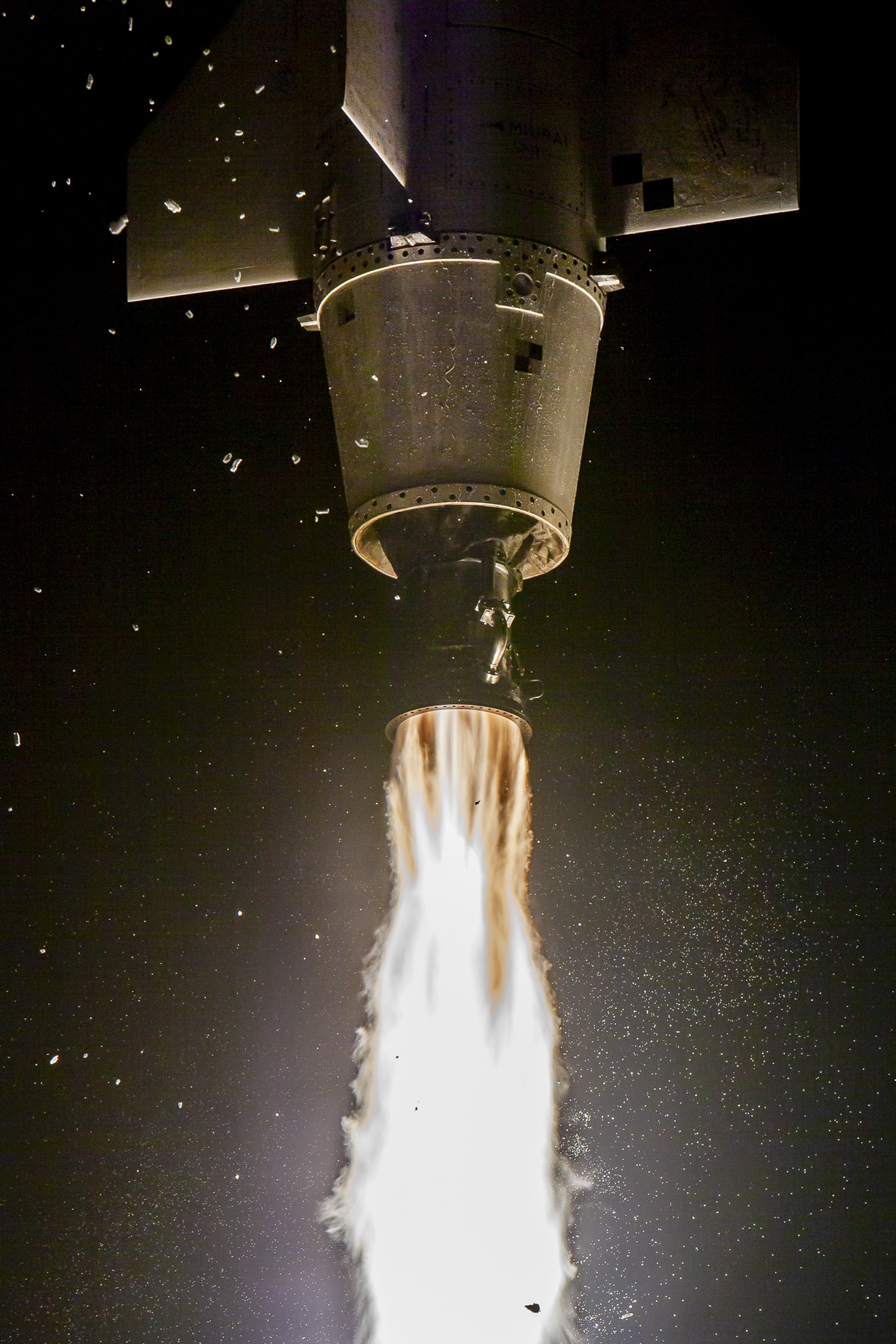
The October 7, 2023 launch fulfilled the mission's primary objectives: engine performance, trajectory tracking, and launcher behavior were all nominal. The 306-second flight reached 46 kilometers — suborbital, but high enough to validate approximately 70 percent of the design and technology intended for the company's real prize: MIURA 5, the orbital launcher.
It is worth pausing here for context. While PLD Space marketed the MIURA 1 flight as "Europe's first fully private rocket launch," the claim requires some asterisks. The Polish company SpaceForest had launched its suborbital Perun rocket in June 2023, and the Dutch firm T-Minus had launched a pair of Kingfisher rockets in October 2022. What PLD Space achieved was the first successful test of a liquid-fueled rocket designed as a technology demonstrator for an orbital-class vehicle — a meaningfully different category, and one that aligns Spain's ambitions with the path SpaceX followed from Falcon 1 to Falcon 9.
MIURA 5: The Orbital Bet
MIURA 5 is where Spain's space ambitions get serious. The two-stage, kerosene-fueled orbital launcher stands 34 meters tall and is designed to deliver up to 540 kilograms to low Earth orbit in its initial configuration, with a roadmap to 1,000 kilograms with an optional kick stage that can circularize satellite orbits. While it will launch in an expendable configuration initially, future variants are designed for first-stage recovery and reuse — a capability that, if achieved, would make PLD Space only the second European entity after ArianeGroup to develop a reusable launch vehicle.
The funding trajectory tells its own story. In March 2026, PLD Space closed a Series C round worth 180 million euros. In April 2026, the European Investment Bank signed a 30-million-euro venture debt loan to support the final development stage. With these additions, PLD Space has secured approximately 380 million euros in total funding — and that figure does not include the 169 million euros committed by the Spanish government through ESA's European Launcher Challenge, which is specifically designed to help MIURA 5 become part of the next generation of European launchers.
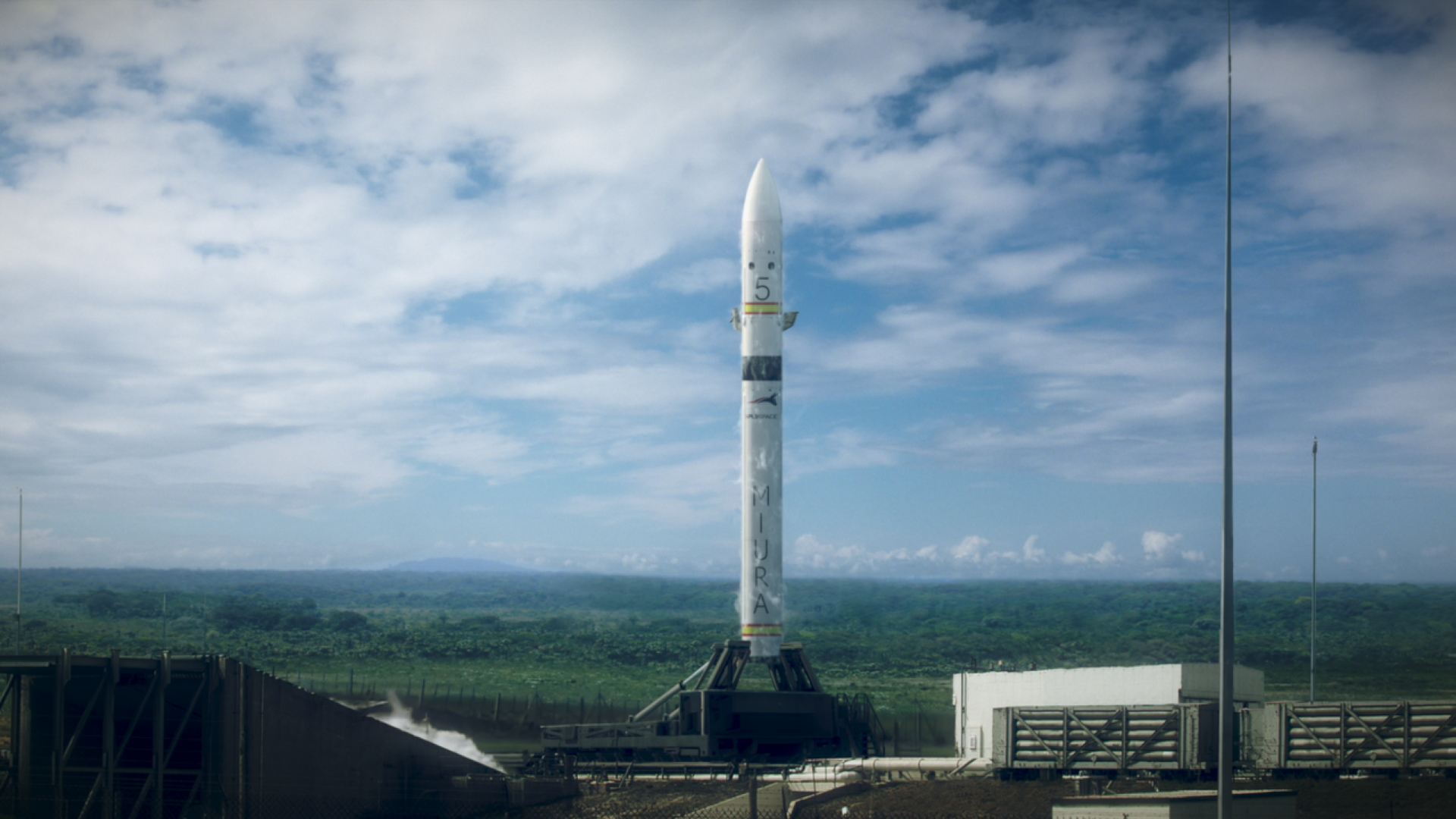
As of early 2026, the rocket is on track for its inaugural demonstration flight from the Guiana Space Centre in Kourou, French Guiana. Manufacturing and integration of two qualification models for the first stage have been completed, and the company's program manager, Giovanni Luca Carollo, has described "tangible progress across manufacturing, integration, testing and launch infrastructure." Commercial launches are expected to begin in 2027, with an eventual target of up to 30 missions per year from multiple spaceports.
Development has been sponsored by ESA via the Future Launchers Preparatory Programme, with additional support from the French space agency CNES and from INTA. It is a genuinely pan-European effort — but the intellectual property, the engineering team, and the corporate headquarters remain in Elche, Spain.
If MIURA 5 reaches orbit on schedule, PLD Space will achieve something no Spanish entity has ever done: independent access to space. For a country that hosted NASA's Moon-tracking antennas but never built its own launcher, it would be a transformation as significant culturally as it is technologically.
Hispasat: Spain's Eye in the Sky and the Gateway to the Spanish-Speaking World

While PLD Space represents Spain's future in launch, Hispasat represents its present in orbit. Established in 1989, Hispasat is Spain's government-backed satellite operator, and its fleet of geostationary communications satellites has quietly become one of the most strategically important assets in the Spanish-speaking world.
From orbital positions at 30.0 degrees West and 61.0 degrees West, Hispasat's satellites cover Europe, the Americas, and North Africa — a footprint that maps almost perfectly onto the global Hispanophone community. The fleet broadcasts more than 1,250 television channels and radio stations to over 30 million homes, while simultaneously providing broadband internet, data transmission, and telephony services to regions where terrestrial infrastructure is absent or unreliable.

The strategic calculus is straightforward. For Spain, whose cultural and economic influence is amplified by a language spoken by more than 500 million people across two continents, satellite communications are not merely a commercial proposition — they are a tool of soft power. A farmer in rural Peru watching Spanish-language television via a Hispasat transponder, or a school in Senegal accessing broadband through Hispasat's African beam, is connected to Madrid in a way that no diplomatic communique can replicate.
In a landmark deal that reshaped Spain's space industrial landscape, Indra — Spain's largest defense and technology company — completed its acquisition of an 89.68 percent stake in Hispasat from Redeia on December 30, 2025, in a transaction valued at 725 million euros, implying an enterprise value of nearly one billion euros for Hispasat. The deal also consolidated Indra's stake in Hisdesat, the sister company that provides secure satellite communications to the Spanish military and allied governments. The newly formed entity, Indra Space, aims to become a Tier-1 European space company with end-to-end capabilities across the satellite value chain.
SpainSat NG: Military Space Comes of Age
The most tangible expression of Spain's growing space sovereignty is the SpainSat NG program — a pair of next-generation military communications satellites that represent Spain's most ambitious space project to date. SpainSat NG I, a 6.1-tonne spacecraft built by a consortium of Airbus Defence and Space and Thales Alenia Space, launched aboard a SpaceX Falcon 9 from Cape Canaveral on January 30, 2025. SpainSat NG II followed on October 24, 2025.
Together, the two satellites replace Spain's aging Spainsat and XTAR-EUR military communications platforms. They combine Ultra High Frequency, Ka-Band, and X-Band technologies into a single satellite — a configuration that handles up to ten times more data than the previous generation. Advanced anti-jamming and anti-spoofing protections, along with hardening against high-altitude nuclear electromagnetic pulse events, make SpainSat NG the backbone of secure Spanish military communications across two-thirds of the Earth's surface.
Spain's Prime Minister announced the entry into service of SpainSat NG-I in August 2025, declaring it a milestone for Spanish defense autonomy. For a NATO member that has historically depended on American and French satellite infrastructure for secure communications, operating sovereign military satellites represents a genuine strategic shift.
Spain Inside ESA: From Minor Contributor to Fourth-Largest Investor
Spain's relationship with the European Space Agency has undergone a transformation that few outside the European space policy community have noticed. For decades, Spain was a middleweight ESA contributor — present in most programs but rarely decisive in any. That changed dramatically at the November 2025 ESA Ministerial Council.
At that meeting, Spain committed 1.854 billion euros to ESA programs for the 2026-2030 period, representing 8.46 percent of the agency's total investment. This was a staggering increase — more than double the 920 million euros pledged at the previous ministerial in 2022, raising Spain's average annual contribution from roughly 300 million euros to approximately 455 million euros. With this commitment, Spain leapfrogged several larger economies to become ESA's fourth-largest contributor, behind only France, Germany, and Italy.
Two investments stand out. First, Spain committed 325 million euros — making it by far the largest single national investor — to ESA's Earth Observation for Reconnaissance and Surveillance (ERS-EO) program, a precursor to the European Union's planned intelligence, surveillance, and reconnaissance satellite constellation known as EOGS (Earth Observation Governmental Service). This is military-relevant Earth observation, and Spain's outsized investment signals an intent to lead rather than follow in European defense space.
Second, Spain invested 169 million euros in the European Launcher Challenge, the ESA program specifically designed to nurture next-generation commercial launchers. This money is, in large part, directed toward PLD Space's MIURA 5 — a level of national commitment that makes clear the Spanish government views autonomous launch capability as a strategic priority, not merely a commercial opportunity.
Spain also participates in IRIS-squared (Infrastructure for Resilience, Interconnectivity and Security by Satellite), the European Union's planned 290-satellite secure communications constellation. Hispasat is a member of the SpaceRISE industrial consortium — alongside Eutelsat and SES — that holds the 12-year concession contract for the constellation's development and operation. When IRIS-squared becomes operational, projected for 2030, Spanish industrial content will be woven into the fabric of Europe's sovereign communications infrastructure.
The Startup Constellation: Spain's Emerging Space Ecosystem
PLD Space may be the most visible Spanish space startup, but it is not alone. Over the past five years, an ecosystem of companies has emerged that spans Earth observation, satellite IoT, propulsion technology, and very-low-Earth-orbit engineering. Collectively, Spain now hosts more than 60 space technology companies — a number that would have been inconceivable a decade ago.
Satlantis: Basque Precision in Orbit
Satlantis, based in the Basque Country, has become one of Europe's most successful Earth observation companies. The company reported revenues of 47.8 million euros in 2025, with more than half derived from small-satellite sales and operations. Its proprietary optical technology enables satellites to continuously acquire images while aggressively maneuvering — a capability that makes its spacecraft unusually versatile for defense, intelligence, and environmental monitoring applications.
The company has launched eight missions to date, including its Garai A and Garai B precursor satellites — named after the Basque explorer Juan de Garai — with Garai B (also designated INNOSAT UNAMUNO) reaching orbit in March 2026. Satlantis has announced plans for five FlexSat Earth-observation microsatellites, with the first scheduled for late 2026, and is developing a 50-centimeter-resolution optical payload called Graphium for 2027.
Perhaps most significantly, Satlantis is partnering with Portugal on the Atlantic Constellation, a fleet of 16 small Earth observation satellites — eight built in Spain, eight in Portugal — dedicated to monitoring climate change in the Atlantic basin. It is a project that marries Iberian solidarity with orbital capability.
Sateliot: Barcelona's Bet on Satellite IoT
Sateliot, headquartered in Barcelona, is pursuing one of the most ambitious connectivity visions in the European space sector: a constellation of over 100 nanosatellites providing global 5G NB-IoT (Narrowband Internet of Things) coverage. The company's pitch is elegant — by extending 5G coverage to areas where no cell tower will ever be economically viable, Sateliot can connect sensors, trackers, and devices across oceans, deserts, farmlands, and polar regions.
As of early 2026, Sateliot has launched multiple satellites, with four additional spacecraft reaching orbit via a SpaceX Falcon 9 in August 2025. Five more satellites, manufactured by fellow Spanish firm Alen Space at its facilities in Nigran, Galicia, are scheduled for launch in 2026. The company holds contracted commitments worth approximately 270 million euros from over 400 clients across 50 countries and has completed a 70-million-euro Series B, with a 100-million-euro Series C underway to fund the full constellation deployment.
In 2024, the European Investment Bank provided a 30-million-euro loan to support Sateliot's satellite network rollout — a sign that EU institutions view satellite IoT as critical infrastructure. The company projects one billion euros in annual revenue by 2030.
Alen Space: Galicia's Satellite Factory
Alen Space, spun out of the University of Vigo in 2017 as part of Galicia's Ignicia innovation program, has evolved from a university project into one of Europe's most capable small-satellite manufacturers. The company designs, builds, and operates nanosatellites and has become a key supplier to the broader Spanish ecosystem — including manufacturing spacecraft for Sateliot's constellation.
In a move that consolidated the Spanish space supply chain, technology multinational GMV acquired Alen Space, integrating it into GMV's global business group. Under GMV's umbrella, Alen Space has expanded its portfolio: the SATMAR maritime monitoring nanosatellite launched in June 2025 aboard a SpaceX Falcon 9, and in March 2026, ESA's Celeste IOD-1 satellite — developed jointly by GMV and Alen Space — successfully launched from New Zealand. The company also leads an ESA project for detecting radio frequency interference from space.
Kreios Space: NATO's Bet on Spanish Propulsion
The most striking validation of Spain's space startup ecosystem came from an unexpected source: NATO. In September 2025, Kreios Space — a Vigo-based company founded in 2021 by six recent university graduates — closed an 8-million-euro seed round led by the NATO Innovation Fund, a one-billion-euro private equity fund backed by 24 NATO allies. It was the NATO Innovation Fund's first direct investment in Spain and the largest European funding round ever in Very Low Earth Orbit technology.
Kreios Space has developed an Air-Breathing Electric Propulsion (ABEP) engine that captures atmospheric particles at altitudes between 150 and 400 kilometers, converts them into plasma, and uses them as propellant — powered entirely by solar energy. The technology eliminates the need for onboard fuel, theoretically allowing satellites to maintain orbits that would otherwise decay within days. After more than five years of development, the engine achieved certification and ground testing in 2026, with the first in-orbit demonstration planned using two test satellites funded by the NATO round.
Pangea Aerospace: Reinventing the Rocket Engine in Barcelona
Pangea Aerospace, based in Barcelona, is developing aerospike rocket engines — a propulsion concept that NASA and the Soviet Union studied for decades but never operationalized. In October 2021, Pangea successfully tested DemoP1, the world's first liquid methane and liquid oxygen aerospike engine that was fully additively manufactured in just two pieces. In 2025, the company secured 23 million euros in Series A funding.
Now, as part of a consortium led by ITP Aero that includes SENER and Aenium Engineering, Pangea is developing the ARCOS aerospike engine — a 750-kilonewton thrust system designed for upper-stage use in medium and heavy launch vehicles. Backed by 11.6 million euros from Spain's CDTI Innovacion and the Spanish Space Agency, ARCOS is designed to enable upper-stage reuse, a capability that only SpaceX has achieved to date. If ARCOS reaches maturity, it could position Spanish propulsion technology at the heart of next-generation European launchers.
The Canary Islands: An Atlantic Launchpad Waiting to Happen
There is a geographic argument for Spain's future as a launch nation that requires only a globe and a protractor. The Canary Islands sit at approximately 28 degrees North latitude — almost exactly the same as Cape Canaveral (28.4 degrees North), the Kennedy Space Center, and the Baikonur Cosmodrome's most-used launch pads. To the west lies nothing but open Atlantic Ocean, an ideal downrange trajectory for eastward orbital launches. To the south, the Canaries are closer to the equator than any point in continental Europe, offering the rotational-velocity boost that makes equatorial launch sites so valuable.

Spain has known this for decades. As far back as the 1960s, Spain lobbied the European Space Agency's predecessors to choose the Canary Islands rather than French Guiana as Europe's primary launch base. France, with its greater weight in the European aerospace industry and the geographic advantage of an actual equatorial territory, prevailed. Kourou, not Las Palmas, became the home of Ariane.
But the argument has resurfaced in the NewSpace era, and it is stronger than ever. The El Hierro Launch Centre is a proposed INTA project to create a civil-use spaceport on the island of El Hierro, the smallest and westernmost of the Canary Islands, dedicated to launching micro- and nanosatellites. Separately, Spaceport Gran Canaria is a facility currently under development for rocket and satellite launches. And the PLOCAN consortium has studied the feasibility of floating launch infrastructure in the maritime zone off the Canaries — an approach that could sidestep the environmental and land-use concerns that have complicated terrestrial spaceport proposals.
The Canary Islands also carry an astronomical heritage that lends credibility to any space-related enterprise. The Roque de los Muchachos Observatory on La Palma, perched at 2,396 meters above sea level on the rim of the Caldera de Taburiente, hosts the 10.4-meter Gran Telescopio Canarias — the largest single-aperture optical-infrared telescope in the world — along with more than twenty other telescopes operated by institutions from across Europe and beyond. The observing conditions that make La Palma one of the world's premier astronomical sites — exceptionally stable atmosphere, minimal light pollution, a temperature inversion layer that traps clouds below the summit — are a testament to the same geographic qualities that make the islands attractive for launch.
If Spain builds a functional spaceport in the Canaries, it would offer European launch customers something that currently does not exist: an orbital launch facility on sovereign European territory that does not require crossing an ocean to reach French Guiana. For small-satellite operators seeking rapid, responsive access to orbit — the market segment PLD Space is targeting with MIURA 5 — the value proposition of a Canary Islands launch site is self-evident.
The Institutional Backbone: A Space Agency, At Last
For a country with INTA's pedigree, Hispasat's fleet, and a growing private sector, Spain was conspicuously late in establishing a dedicated national space agency. France had CNES (1961), Italy had ASI (1988), Germany had DLR's space program embedded since the 1960s. Spain had INTA, CDTI, and various interministerial committees, but no single coordinating body.
That changed in 2023. On March 7, the Council of Ministers approved the internal regulations for the Agencia Espacial Espanola (AEE) — the Spanish Space Agency — with its Governing Council holding its constitutive session on April 20. The agency is headquartered in Seville, a city that is home to 71 percent of Andalusia's aerospace companies and that has positioned itself as the "space capital of Southern Europe." The AEE launched with an initial budget of 700 million euros and a mandate to coordinate Spain's space activities across research, development, defense, and commercialization.
The choice of Seville was not accidental. Airbus Defence and Space operates major satellite integration facilities in the city. The region's universities and research centers provide a talent pipeline. And the symbolic resonance — Seville was the port from which Spain's Age of Discovery expeditions departed in the fifteenth and sixteenth centuries — was not lost on the government's communications team.
The AEE's existence matters because it provides a single interlocutor for ESA, the European Commission, NATO, and bilateral partners. When Spain committed 1.854 billion euros at the 2025 ESA Ministerial, it was the AEE that coordinated the national position. When PLD Space negotiates launcher-related programs with ESA, the AEE provides the institutional framework. In the bureaucratic reality of European space politics, having a dedicated agency is less a luxury than a prerequisite for being taken seriously.
The Numbers Behind the Ambition
Spain's space sector had a turnover of 1.065 billion euros in 2021, accounting for roughly 0.1 percent of national GDP. The aerospace sector more broadly contributes approximately 2.3 billion euros annually and supports over 24,000 direct jobs. According to Spain's Minister of Science, Innovation, and Universities, every euro invested in the space sector generates up to four euros for the broader economy — a multiplier effect driven by technology transfer, high-skilled employment, and downstream applications.
The Spain Satellite Communications Market alone is projected to reach 850 million dollars in 2025, growing at nearly 12 percent annually to reach 1.49 billion dollars by 2030. Add Earth observation, launch services, navigation, and space-based IoT, and the total addressable market for Spanish space companies is measured in the billions.
The trajectory of investment tells its own story. Spain's ESA contribution has grown from roughly 300 million euros per year to 455 million euros per year. PLD Space alone has secured 380 million euros in private and institutional funding. Hispasat was acquired for nearly one billion euros in enterprise value. Kreios Space received NATO backing. Satlantis doubled its revenue year over year. These are not the financial signatures of a dormant sector.
Future Outlook: The Making of a Launch Nation
Spain's space sector in 2026 occupies a peculiar position: simultaneously mature and nascent, rich in heritage and hungry for firsts. INTA is 84 years old. Hispasat has been operating satellites for more than three decades. Yet Spain has never placed a payload in orbit under its own power, and the Agencia Espacial Espanola is barely three years old.
The convergence of forces is striking. A national space agency with a 700-million-euro budget. ESA's fourth-largest contributor status. A private launch company on the verge of its first orbital flight. A satellite operator newly consolidated under a defense-technology giant with Tier-1 European ambitions. A startup ecosystem spanning Earth observation, satellite IoT, novel propulsion, and very-low-Earth-orbit technology. A geographic asset — the Canary Islands — that is arguably the most strategically located potential spaceport in Europe. And a cultural moment in which Spain, buoyed by a strong economy and a growing technology sector, is ready to claim a role that its infrastructure has long supported but its institutions never fully coordinated.
The comparison that Spanish space officials quietly make is with Italy — a country of similar economic weight that punches well above it in European space politics, thanks to decades of sustained investment and strong industry champions like Leonardo and Avio. Spain's argument is that it is now making the same bet, just later, and with the advantage of a startup ecosystem that Italy's more consolidated industrial base lacks.
Whether Spain becomes a genuine launch nation depends, ultimately, on MIURA 5. If PLD Space's orbital rocket flies successfully in 2026 and enters commercial service in 2027, Spain will join an extraordinarily exclusive club — fewer than a dozen countries have ever achieved independent orbital launch capability. If the Canary Islands spaceport materializes, Spain will offer something unique in Europe: a launch site on sovereign soil with open-ocean downrange safety, equatorial proximity, and excellent weather. If Hispasat, Satlantis, Sateliot, and Kreios Space continue their growth trajectories, Spain will have not just a launcher but a customer base to fill it.
The Spanish proverb says it well: "Poco a poco se va lejos" — little by little, one goes far. Spain has been going little by little in space for 84 years. The distance it has covered is, finally, becoming visible.